2025-12-29
THE IMPACT OF FINANCIAL TECHNOLOGY ON CORPORATE TREASURY FUNCTIONS
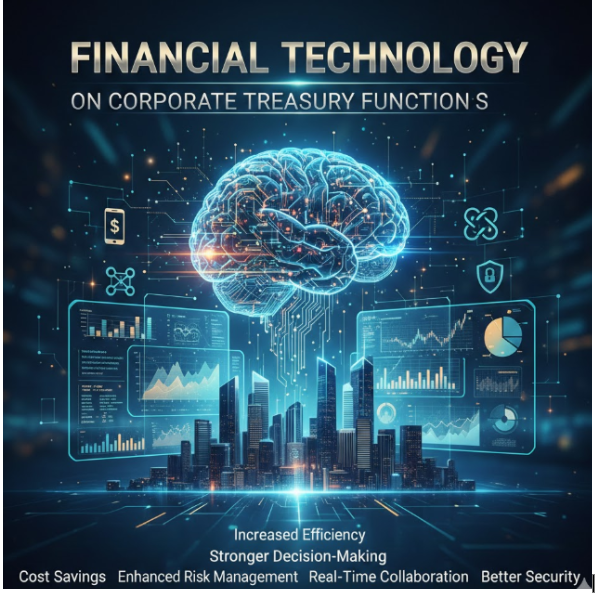
FinTech improves corporate treasury functions by automating tasks, providing real-time financial visibility, reducing costs, and strengthening risk management. It helps treasurers work more efficientl
1. What is Financial technology and corporate treasury functions ?
Financial Technology is also called as fintech, refers to the use of technology to improve financial services and processes. It combines finance with innovations like software, algorithms, apps, and devices to make managing money faster, easier, and more accessible. Some common example are Mobile banking app, Online payment platforms, Cryptocurrency and block chain technologies etc.
Corporate treasury functions refer to the responsibilities and activities managed by a company’s treasury department, which is primarily focused on managing the firm's financial assets, liquidity, and financial risk. In essence, the corporate treasury plays a crucial role in keeping the company financially stable, efficient, and secure. Some of the example are Cash and Liquidity Management, Banking Relationships, Risk management, Investment Management etc.
2. Introduction
In today’s Business world Fintech integrate modern technology into financial services to improve efficiency, security, and accessibility. When applied to corporate treasury functions, fintech offers advanced tools that automate routine tasks, enhance decision making through data analytics, and improve real-time visibility into financial positions. This transformation allows treasurers to shift their focus from manual operations to strategic planning.
3. Impact
• Increased Efficiency- Fintech can automate repetitive and time-consuming tasks such as payment processing, bank reconciliations, cash flow forecasting, and reporting. By reducing manual work, treasury teams can complete tasks in a fraction of the time and with fewer errors. This leads to faster month-end closings, more accurate data entry, and streamlined operations.
• Greater Visibility-Fintech tools provide real-time dashboards and analytics, offering treasurers a clear and consolidated view of the organization’s cash position across global bank accounts and subsidiaries. This visibility helps in making informed decisions quickly and managing liquidity more effectively.
• Stronger Decision-Making-With access to real-time financial data and advanced analytics, treasurers can make smarter decisions related to cash investment, borrowing, and risk management. Predictive analytics and AI tools also allow treasury to model different financial scenarios and assess their outcomes. Stronger Decision-Making.
• Cost Savings-Fintech reduces operational costs in multiple ways such as, digital transactions reduce banking fees, and improved accuracy minimizes the cost of errors and penalties. It also eliminates the need for multiple software systems by integrating functions into a single platform.
• Enhanced Risk Management-Fintech tools allow treasurers to proactively identify, assess, and manage financial risks such as currency fluctuations, interest rate changes, or counterparty defaults. Advanced platforms provide Real-Time Collaboration and Integration
• Real time collaborations and Integrations-Fintech platforms integrate easily with ERP and accounting systems, enabling seamless data flow between departments. Treasury can coordinate with finance, procurement, and operations without relying on disconnected spreadsheets me risk metrics and simulate “what-if” scenarios to help mitigate potential losses.
• Better Security and Fraud Detection-With increasing cyber threats, fintech tools now offer enhanced security features like AI-driven fraud detection, block chain based transaction records, and multi-layered authentication to protect financial data.
4. Conclusion
Fintech is no longer optionalit’s essential for modern treasury operations. As digital tools continue to evolve, treasurers must embrace technology, upskill teams, and lead innovation to drive financial efficiency, reduce risk, and add strategic value to the business. The treasury of the future is agile, data-driven, and powered by fintech.